

UMKT Study Reveals Gen Zs Were Bad at Comprehending English Texts
Author: Raisha Azzahro
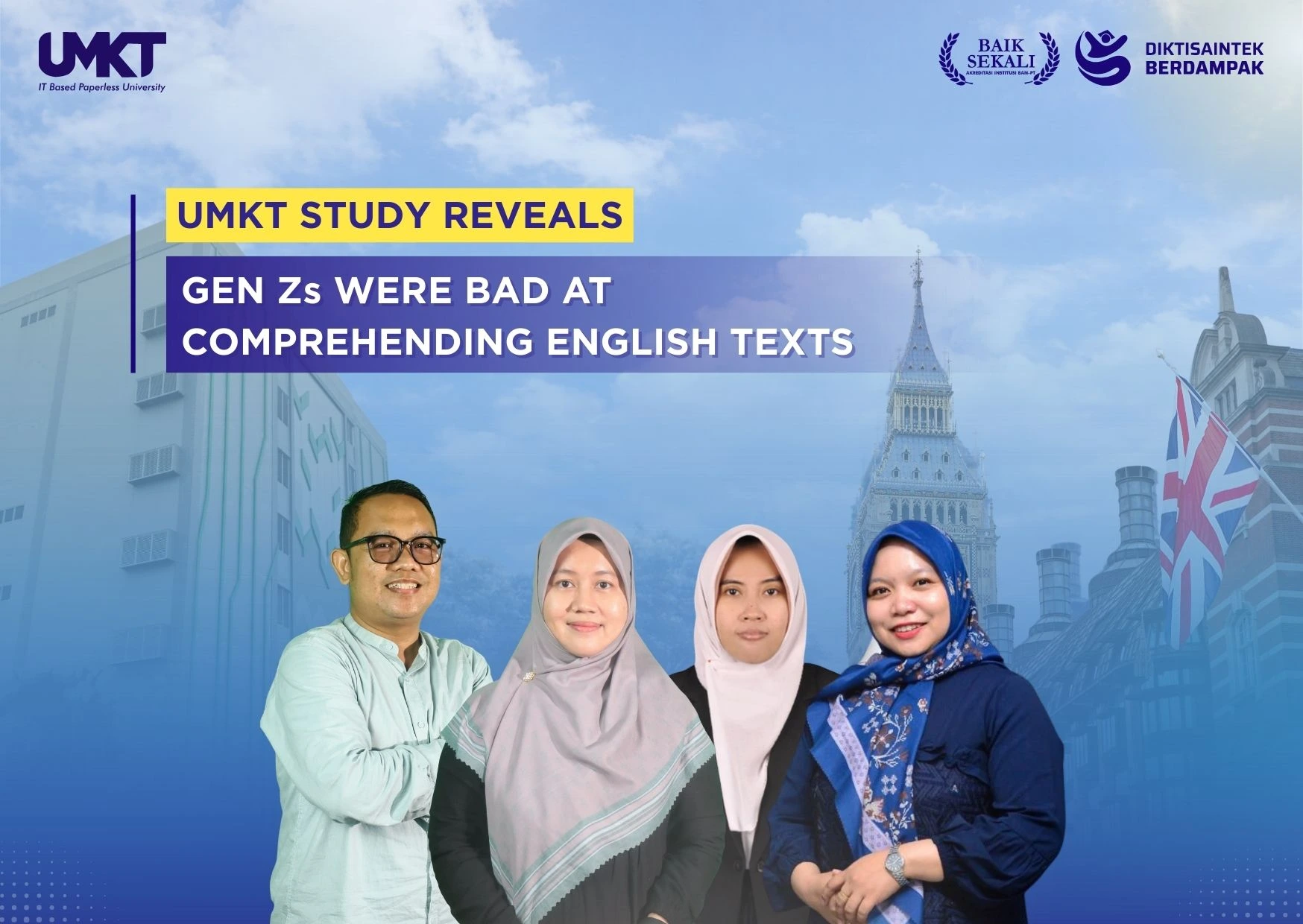
umkt.ac.id, Samarinda — A recent study titled "Students’ Reading Comprehension of English Textual Literacy Among the Zillennial Generation" has been published by a team of researchers from the English Education Study Program at Universitas Muhammadiyah Kalimantan Timur (UMKT). The team, consisting of Yeni Rahmawati, Khusnul Khatimah, Dzul Rachman, and Sunarti, sought to address the persistent challenges Indonesian students face when navigating English-language texts.
Lead researcher Yeni Rahmawati noted that for many students, the leap from reading in Indonesian to comprehending English is significant. The study was born out of a critical observation: while "Zillennials" (Gen Z) are immersed in an information-rich environment, there is a startling lack of data regarding their actual comprehension levels as they move through the education system.
"We identified a need for descriptive research that could truly map out how these students process information," Yeni explained.
The core focus of the research was the role of rapidly evolving technology, particularly Artificial Intelligence (AI). While AI has made information more accessible than ever, the researchers found that it has also introduced a new cognitive hurdle: the habit of seeking "instant" answers.
"This digital environment encourages a pragmatic approach. Students often choose the path of least resistance—skimming for quick results—rather than engaging in the deep reading process required for true literacy," Yeni observed.
The findings reveal a stark paradox: while students have a high "textual literacy rate" (the ability to read the words), their actual level of comprehension is alarmingly low. The study suggests that English literacy among the Zillennial generation is not developing effectively, especially when encountering intermediate or advanced materials.
The researchers conclude there are three primary obstacles to comprehension: identifying implied meanings, grasping complex main ideas, and synthesizing information that requires high-order reasoning.
These findings mirror international benchmarks like the PISA (Programme for International Student Assessment) results, which consistently place Indonesian students’ literacy levels on the lower end of the global spectrum.
The UMKT team emphasizes that closing this literacy gap requires a unified effort from schools, teachers, parents, and the wise integration of technology.
"Reading should not be viewed as a burden, but as a platform for cognitive development," the researchers noted. They advocate for a shift in pedagogy: moving away from result-oriented teaching toward an approach that nurtures critical, inferential, and reflective thinking skills.
For higher education, the findings highlight an urgent need to modernize teaching methods to be more innovative, context-sensitive, and interactive. Simple strategies, such as optimizing "reading corners" with materials aligned with student interests and involving parents in fostering reading habits at home, are recommended as early intervention steps.
Representing the research team, Yeni concluded by asserting that technological advancement does not automatically guarantee improved literacy. True reading is a collaborative and conscious habit that must be built over time.
"This research is a call to action for educators and stakeholders to sow the seeds of sustainable reading habits," Yeni said. "Technology should be utilized as a supportive platform for growth, rather than a replacement for the essential process of literacy."
Also read in KapanLagi.
Author: Raisha Azzahro
Translator: M. Rafly Raihandy