

UMKT Researchers Innovation: Pregnant Supplement from Kelakai and Guava
Author: Raisha Azzahro
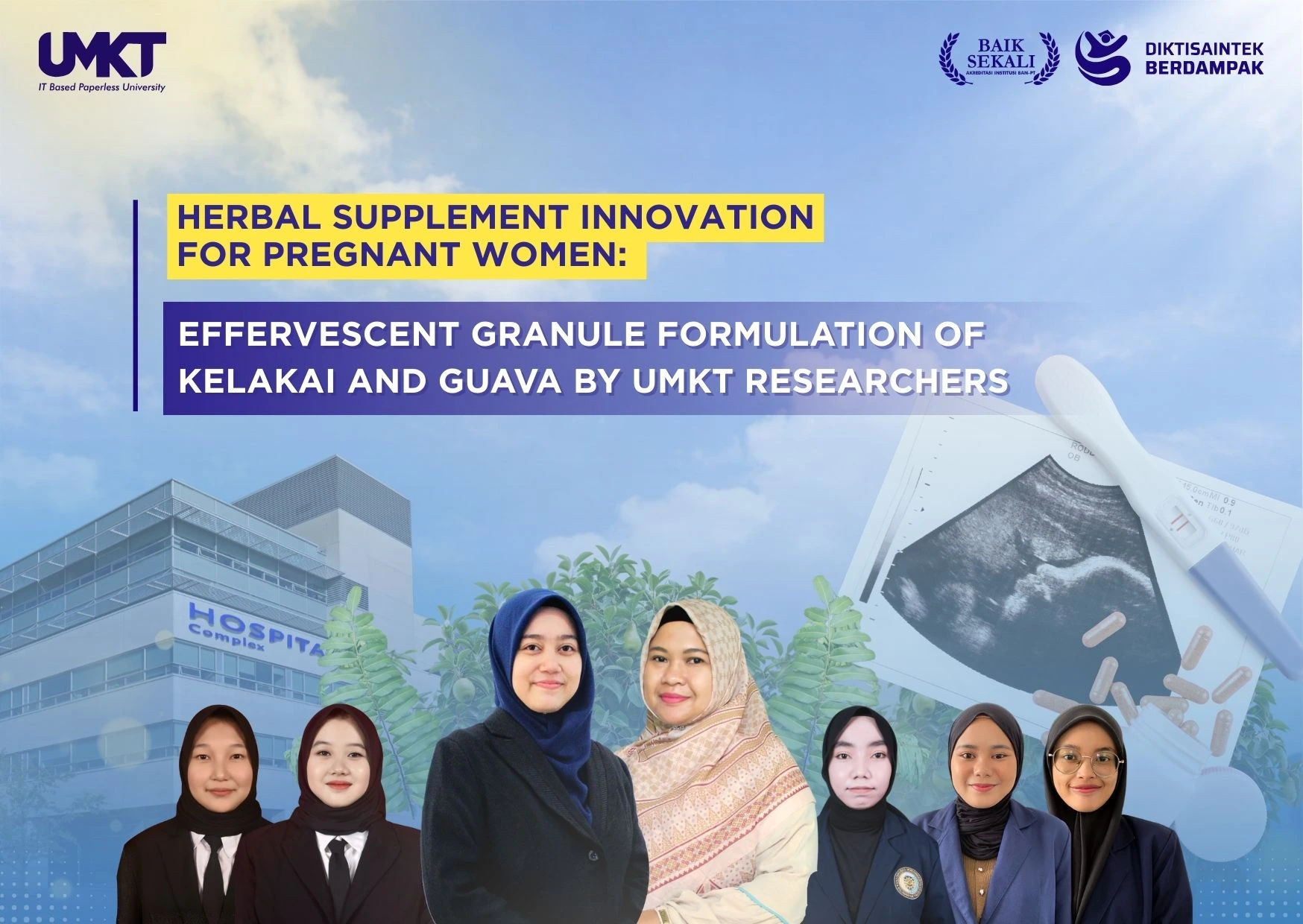
umkt.ac.id, Samarinda — Maternal mortality rates in Indonesia remain a pressing concern, with nutritional deficiencies — specifically iron, folic acid, and calcium — identified as leading contributors to complications during pregnancy. While supplements are widely available, many expectant mothers are reluctant to take them due to the unpleasant metallic taste of iron.
Addressing this challenge, Indah Hairunisa, a lecturer at the Faculty of Pharmacy, Universitas Muhammadiyah Kalimantan Timur (UMKT), has spearheaded the development of an innovative herbal supplement in the form of effervescent granules. Developed in collaboration with fellow lecturer Tri Budi Julianti and a team of five students, the supplement utilizes the potent properties of Kelakai (Stenochlaena palustris) leaves and Red Guava (Psidium guajava).
Stenochlaena palustris, a fern native to Kalimantan, is naturally rich in calcium and iron. Clinical studies have indicated that consuming Kelakai can significantly boost hemoglobin levels in anemic pregnant women.
By selecting Kelakai, the research team aims to highlight the untapped potential of Kalimantan’s local flora. Red Guava was added to the formula not only for flavor but for its high Vitamin C and folic acid content, which are essential for red blood cell formation and for ensuring optimal iron absorption in the body.
A key highlight of this innovation is its delivery method. Effervescent granules are designed to dissolve in water, creating a refreshing, bubbling drink.
"This format was chosen for its practicality and palatability," the team explained. "The sparkling sensation and customizable flavor profile effectively mask the bitterness often associated with iron supplements. Because it is a drink, it is much easier for mothers to consume compared to large pills that must be swallowed or crushed."
The researchers believe this "user-friendly" approach will significantly improve supplement compliance among pregnant women who struggle with nausea or taste sensitivities.
The research team tested three distinct variations, adjusting the ratios of citric acid and tartaric acid to achieve the perfect effervescent effect. Each formula underwent rigorous physical testing, including sensory evaluations (color, aroma, and taste), dissolution time, pH levels, moisture content, and foam stability.
The results identified Formula III — featuring a citric-to-tartaric acid ratio of 9:3 — as the most effective. This version boasted the fastest dissolution time (approximately two minutes), low moisture content, and stable physical characteristics. From a sensory perspective, the granules produced a pleasant guava aroma and a balanced sweet-and-sour taste with a satisfying "explosive" fizz.
The Path to Mass Production
While the initial results are promising, the researchers noted that certain parameters, such as granule flow rate and foam height, require further refinement to meet ideal industrial standards. Future steps include quantitative testing for iron (Fe) and calcium (Ca²⁺) content, safety and efficacy trials on animal models, and long-term stability testing.
"Our ultimate goal is to collaborate with the manufacturing industry for mass production," stated Indah Hairunisa. "Scaling up and 'downstreaming' the product is our final target once all safety and efficacy requirements are fulfilled."
Through this innovation, UMKT reaffirms its commitment to providing science-based solutions that address community health needs while promoting local biodiversity as a cornerstone of future medical breakthroughs.
Author: Raisha Azzahro
Translator: M. Rafly Raihandy